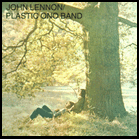
Both Yoko Ono, who coproduced it, and Klaus Voormann, who played bass on it, say they believe John Lennon's "Plastic Ono Band" is "timeless." Indeed, it sounds as if it could have been released yesterday. The instrumentation - Lennon on guitar and piano, Voorman on bass, Ringo Starr on drums - is stripped to the bone. In resonantly simple language - language that deviates sharply from what Lennon dismissed at the time as the "self-conscious poetry" of songs like "Lucy in the Sky with Diamonds" - he takes on basic issues: death, isolation, anger, class, fear. He attacks what he saw as the illusions of the Sixties, bidding goodbye to that decade with the unsentimental announcement "The dream is over." And when he declares, "Now I'm reborn," in "God" it couldn't be any plainer: the Beatles are dead, and John Lennon and Yoko Ono are standing alone.
"Plastic Ono Band" is dedicated to Yoko, who is also obliquely cited as the album's inspiration in the credits: "Yoko Ono: Wind." Most of the songs on the record were written while John and Yoko were undergoing prima-scream therapy with Dr. Arthur Janov in California in 1970. Primal-scream therapy, which Janov founded, asserts that people can grow emotionally only when they break through the superficialities of life and express their own personal pain, staring with repressed memories from infancy. Lennon had never resolved his feelings about his mother, who died when he was a teenager, and his father, who abandoned him as a child. He had also recently divorced his first wife, had split up with the Beatles and had briefly been addicted to heroin. In short, he had plenty of pain to confront - and all of it emerges undisguised on "Plastic Ono Band."
After his time with Janov, Lennon was like a raw nerve; with characteristic honesty, he wanted to capture that rawness on record. He contacted Ringo and his longtime friend Klaus Voormann. He also brought in producer Phil Spector, who had worked on "Let It Be" and "Instant Karma." The album was recorded at EMI's Abbey Road studio, in London. "As soon as we came into the studio," Voorman says, "we noticed that he was very much taken by that experience he went through [with Janov], and he wanted, as quick as possible, to get this feeling down before it changed. That was his main thing."
For that reason - and also because Lennon wanted to shed the trappings of the Beatles' lush sound, which he associated with Paul McCartney and George Martin - the sessions proceeded rapidly and with little fuss. "He did not want to make a production with lots of instruments and great arrangements," Voormann says. "The main thing was that he wanted to do something as fresh and direct as possible. Just the fact that he asked Ringo and myself to play on the album meant to me that he wanted it be a real close, intimate atmosphere. He did not say very much about what we played. He just played the song, and Ringo and I played the simple way we both enjoy playing. And it seemed to be exactly what he was looking for.
"The playing itself, to him, was not that important," Voorman says. "It was more important to capture the feeling. We did mostly one or two takes. There's a lot of mistakes on there and timing changes, but it was just like a pulse, exactly what John wanted. He loved it." According to Yoko, the sessions were infused with "an incredible feeling of energy, of starting something new." To keep things moving, Spector was doing mixes while the band was recording.
The simplicity of the arrangements on "Plastic Ono Band" only increases the power of Lennon's emotion. The anger Lennon had stored up for years - "so much pain/I could never show it," is how he puts it on "Plastic Ono Band's" chilling coda, "My Mummy's Dead" - burst forth in his sessions with Janov. This passage from Lennon's interview with ROLLING STONE shortly after the album's release demonstrates how extreme the passions were that he was tapping at the time: "One has to completely humiliate oneself to be what the Beatles were, and that's what I resent. I mean I did it, I didn't know, I didn't foresee; it just happened bit by bit, gradually, until this complete craziness is surrounding you and you're doing exactly what you don't want to do with people you can't stand, the people you hated when you were ten.
"And that's what I'm saying on this album - I remember what it's all about now, you fuckers - fuck you! That's what I'm saying, you don't get me twice."
"Plastic Ono Band" opens with "Mother," a stately ballad about the helplessness John felt at his mother's death and his father's departure. It ends with him screaming repeatedly, "Mama don't go/Daddy come home," as if he were wrenching the words from his guts. The riveting "Working Class Hero," which Lennon plays solo on acoustic guitar, grimly details how class oppression warps the people at the bottom of the social system: "They hurt you at home and they hit you at school/They hate you if you're clever and they despise a fool/Till you're so fucking crazy you can't follow their rules/A working class hero is something to be."
The merging of Yoko's and Lennon's lives is also an important aspect of "Plastic Ono Band." According to Voormann, their intense bond was quite evident during the sessions, as it is on songs like "Hold On," "Isolation," "Love," and "Look at Me." "Ringo was a little confused," Voorman says, "Because John's closeness to Yoko was sad to him. John was not one person, John and Yoko were one person, which was very difficult for him to accept."
"God," however, is the album's seminal track and definitive statement. Much as he peeled back the layers of his personality to reach emotional bedrock in his primal-scream therapy, Lennon rids himself in that song of every belief or idol he ever had. The song is Lennon's fervent, determined, almost willful effort to locate a sense of who he is independent of all externals. Over pianist Billy Preston's simple, emphatic chords, Lennon sings, "God is a concept/By which we measure our pain," and chants a litany of abandoned "gods" that concludes, "I don't believe in Elvis/I don't believe in Zimmerman/I don't believe in Beatles/I believe in me/Yoko and me/And that's reality."
This was tough, uncut stuff, and it didn't send fans of Beatle John scurrying to the record store. "People underestimated it," says Voormann, "and they expected something else. But John couldn't care less." Yoko Ono agrees. "Plastic Ono Band" is, she says, "just as important as "Sgt. Pepper," in terms of being a milestone and in terms of the direction that John took after that. The album characterized the direction we were in together, and because of that, a lot of people resented it. Like 'the dream is over/What can I say?' - and they were saying,
'Please, don't let the dream be over. Let us keep on dreamin.